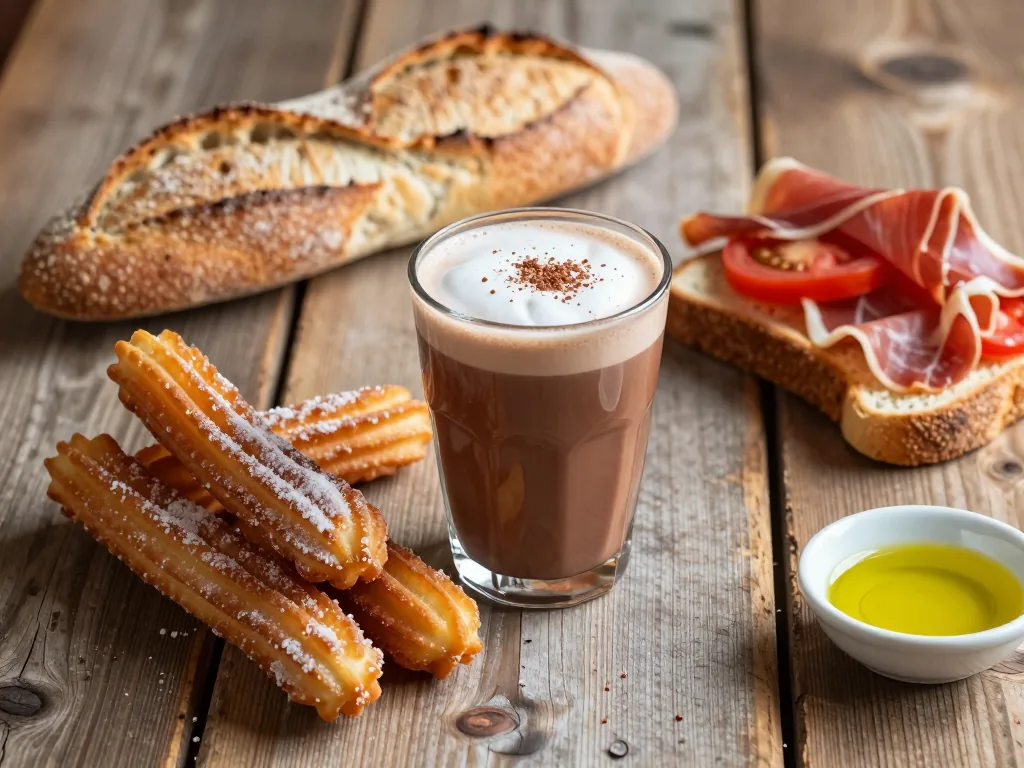
Most visitors make a beeline for churros, but the local morning ritual is quieter, more savory—a slow dance of toasted bread, olive oil, and a tiny cup of bittersweet coffee. Standing at a bustling bar counter, overwhelmed by the chalkboard and rapid-fire Spanish, you know the anxiety of missing the real deal. This insider’s guide cuts through the tourist noise to decode the classic Spanish breakfast, from the essential tostada con tomate to the regional cult of mollete and the perfect café con leche. By the time you finish, you’ll know what to order in 2026—and exactly how to ask for it like a regular, making your morning as authentic as the cobblestones beneath your feet.
Understanding the 2026 Spanish Breakfast Mindset
The Light Meal Principle
In 2026, the Spanish desayuno remains deliberately light and quick—fuel for the morning, not a feast. Forget the groaning boards of eggs, bacon, and pancakes that define an English or American breakfast; the Spanish approach is almost monastic in its restraint. The ritual centers on a single hot beverage—usually a café con leche, a cortado, or, increasingly, a proper barista-made specialty coffee—paired with one simple carbohydrate: a tostada, a slice of crusty bread, or a small pastry. The entire transaction, from ordering to finishing, should take under fifteen minutes. This isn’t a meal to linger over; it’s a strategic pitstop. The goal is to bridge the gap until the much larger midday meal, la comida, which in 2026 still typically unfolds between 2:00 and 3:00 PM. A heavy breakfast would be counterproductive, dulling your appetite and leaving you sluggish before the main event. You’re aiming for a gentle energy lift, not a food coma.
Time and Place: The Bar Counter Culture
Timing is non-negotiable. Breakfast in Spain runs on a tight, unforgiving schedule: roughly from 8:00 AM to 10:30 AM. By 10:45, the kitchen has usually shut its breakfast window, and you’ll be left staring at a menu of pre-lunch snacks. Locals don’t linger at home; they stop at their regular neighborhood bar on the way to work. The default posture is standing at the bar (en la barra), not occupying a table. It’s faster, cheaper, and socially expected. Order directly from the bartender, who is often juggling three espressos and a stack of newspapers. Don’t wait to be seated—just walk up and state your order with confidence. Payment is fluid: either pay immediately when ordering or after you finish. To clarify, you can simply ask “¿Te cobro?” (Do I pay you now?) or, more commonly, wait until you’re done and signal for the bill. The key is to know what you want; hesitation at the counter is a faux pas. A typical 2026 price for a café con leche and a tostada with tomato and olive oil runs from €2.50 to €4.50 per set, depending on the bar’s location and whether it’s a hip specialty café or a classic neighborhood joint.
Any traditional Spanish breakfast—whether you’re leaning against a marble-topped bar in Madrid or settled on a sunny terrace in Seville—starts with two non-negotiable pillars: a properly made coffee and a slice of toasted bread. This isn’t a meal of eggs or pancakes. It’s a ritual of contrast: bitter and milky, crisp and oily, salty and sweet. Master these two elements, and you’ve unlocked the entire morning culture.
Your breakfast is defined by your coffee order. The undisputed standard is the café con leche—a double shot of espresso cut with equal parts hot, steamed milk, served in a thick glass or a small ceramic cup. Smooth and comforting, it’s meant to be sipped slowly while you survey the morning paper or the street outside. If the con leche feels too heavy, order a cortado: the same espresso but with just a splash of milk to soften the edge, leaving the coffee’s intensity front and center. For the truly bold, a solo—a straight, unadulterated espresso—is the purist’s choice, often downed in two quick sips at the bar. Tea (té) technically exists on every menu, but ordering it will immediately mark you as a tourist; Spaniards treat breakfast tea as a medicinal afterthought, not a morning ritual. Expect to pay from €1.20 to €2.50 per coffee, depending on whether you sit at the bar or take a table.
The bread arrives next, always toasted—pan tostado—and almost always as a simple, rustic slice of country loaf. Within seconds of sitting down, you’ll be asked: “¿Aceite y tomate, o mantequilla y mermelada?” (Oil and tomato, or butter and jam?). Do not hesitate. The first option, pan con tomate, is the crown jewel of Spanish breakfasts: a slice of toast rubbed with a ripe, halved tomato until the pulp soaks into the crust, then drizzled with fruity olive oil and a pinch of salt. Some places add a whisper of garlic, but it’s optional—ask for it sin ajo if you prefer a cleaner flavor. The second option is simpler: soft butter and a generous smear of mermelada (usually strawberry or peach), a sweeter, more childlike choice that still holds cultural weight. A single serving of toast with toppings will run you from €1.50 to €3.50. Order both your coffee and toast together, and you’ll have a complete, authentic breakfast for under €6—a small price for a ritual that sets the tone for the entire Spanish day.
Regional Variations: What to Order Where
Spain’s morning table is no monolith. It shifts with the geography, and ordering blindly from a national menu will leave you missing the point. In 2026, the smart traveler lets the region dictate the plate. Head south to Andalusia, and you’ll find the mollete—a soft, round, slightly chewy bread that reigns supreme at sunrise. Unlike the crusty baguettes of the north, the mollete is split and toasted only until its interior turns pale and pillowy, then dressed simply. The savory standard is mollete con jamón: a generous slick of extra virgin olive oil and a few folds of jamón serrano. For a sweeter start, ask for mollete con aceite with butter and sugar—a nostalgic combo locals grew up on. Either way, expect to pay €2.50 to €4.50 per serving in a neighborhood bar. And don’t ask for it “toasted hard”; you want that yielding crumb.
Cross over to Catalonia, and Barcelona’s answer is pa amb tomàquet, which is emphatically not the pan con tomate you might know. The bread—often a rustic country loaf—is barely toasted. Then a ripe tomato is cut in half and rubbed vigorously across the surface until only a pulp remains, staining the crumb deep red. This isn’t a chunky topping; it’s a flavor base. From there, you build: a thin layer of olive oil, then either embutidos (cured meats like fuet or lomo) or a slice of Manchego cheese. Pair it with a café con leche, and you have a breakfast that’s both light and deeply savory. It costs €3.00 to €6.00 per plate, depending on the meat.
Madrid, meanwhile, offers a weekend indulgence: porras, the thicker, fluffier, greasier cousin of churros. These aren’t for daily consumption—they’re a Saturday or Sunday ritual, dunked into a cup of dense hot chocolate that’s more pudding than drink. For a weekday alternative, the Basque Country leans into bakery culture. Ask for a slice of bizcocho (a moist sponge cake) or a carolinas, a small pastry crowned with meringue, served alongside a vaso de leche (a glass of milk) or a cortado. These pastries generally run €1.80 to €3.50 each, and they prove that the Spanish breakfast is as much about place as it is about palate.
When Churros Are Actually Appropriate
The Weekend and Holiday Rule
Ordering churros on a Tuesday at 8:30 AM will mark you as a tourist faster than a map in hand. Let’s be direct about that. In Spain, churros con chocolate—those ridged, golden sticks of fried dough served with a thick, pudding-like hot chocolate—are a weekend and holiday ritual, not a weekday fuel-up. The tradition is anchored to leisure. Families and friends gather for this indulgence on Saturday or Sunday mornings, often stretching it into a lazy mid-morning affair around 11 AM, when the chocolate is still steaming and the café is buzzing with unhurried conversation. On a workday, Spaniards grab a quick tostada with olive oil and tomato, or a café con leche standing at the bar. So if you want to fit in, save churros for a Saturday, a Sunday, or a public holiday. And when you do order, share a portion. A full serving is meant for two or three people; ordering a solo plate is both excessive and, frankly, a rookie move. Expect to pay from €3.50 to €6.50 per portion (around 6–8 churros plus a cup of chocolate), depending on the neighborhood and whether the café is a classic or a tourist-trap.
How to Eat Them Properly
When your order arrives, the chocolate will be served in a small, wide cup—dense, glossy, and almost spoonable. The rule is simple: dip, don’t pour. Never drizzle the chocolate over the churros; that turns a delicate ritual into a soggy mess. Instead, tear off a bite-sized piece, dunk it into the chocolate, and let the excess drip back into the cup for a second before eating. The chocolate is meant to cling to the crisp exterior, not soak it. And don’t dawdle—the chocolate thickens as it cools, and the churros lose their crackle within minutes. Consume them quickly, alternating between bites and sips of café con leche to cut the sweetness. If you want the flavor without the heaviness, ask for churros sin chocolate—just the fried dough, dusted with sugar—and pair it with a café con leche. This is a lighter, more common option for those who find the chocolate cloying, and it lets you enjoy the texture without the sugar rush. Either way, you’re participating in a ritual that’s about savoring the moment, not just fueling up for the day.
The Full Breakfast Deal and the Village Breakfast
To eat like a local and dodge the tourist menus, walk into any Spanish bar and ask for un desayuno completo—a full breakfast—or, in smaller towns, un desayuno de pueblo, the village version. These unwritten set menus exist in nearly every neighborhood bar, yet they rarely surface on English-language boards. Ordering one is both the best value and the simplest move: a single fixed price covers everything, sparing you the awkward back-and-forth of piecing together components. The formula is deceptively simple. You get a café con leche—strong espresso cut with hot milk—plus a slice of toasted bread and a small glass of freshly squeezed orange juice. The toast arrives with your choice of topping, most often crushed tomato and olive oil, plain olive oil with a pinch of salt, or butter and jam. Many bars let you upgrade to pan con tomate for a richer version, but the classic desayuno completo already includes the tomato option at no extra cost. Just say, “Un desayuno completo, por favor,” and the bartender knows exactly what to prepare. Expect to pay anywhere from €3.50 to €6.00, depending on the city and whether you sit at the bar or on the terrace.
Now, about that orange juice. The zumo de naranja natural is non-negotiable in a full breakfast, but it comes with two unspoken rules. First, it’s always served in a small glass—roughly 150 milliliters—never a pint or a tall one. This isn’t skimping; it’s the correct portion, meant to be sipped alongside coffee and toast, not drunk as a standalone beverage. Second, the juice is squeezed to order, so expect a short wait while the bartender feeds oranges into the machine. Don’t ask for a bigger size; you’ll only get a confused look. Prefer it without pulp? Say “sin pulpa,” but most locals drink it as is, pulp and all, since the slight bitterness balances the coffee’s sweetness. Accept the small glass, embrace the pulp, and you’ll be eating—and drinking—exactly the way Spain does.
Navigating the Menu and Ordering Like a Local
Abandon the idea of a singular, fixed “menu.” There is no laminated card with a photo of a full English-style plate. Instead, the bar’s chalkboard—or the verbal offer from the camarero—presents a series of building blocks: bread, tomato, oil, ham, and coffee. You assemble your own morning, and locals do this with quiet, practiced efficiency. The key is to speak in their shorthand.
Key Vocabulary to Use
Master these five phrases, and you will be treated not as a tourist but as someone who understands the day’s rhythm. Start with coffee: “Un café con leche, por favor” is your standard, milky morning fuel, served in a glass or a sturdy ceramic cup. For a sharper kick, try “¿Me pones un cortado?”—an espresso shot “cut” with a splash of warm milk. For food, the most common order is “Una tostada con tomate y aceite”—rustic bread, toasted, rubbed with fresh tomato pulp, and drizzled with olive oil. In Andalusia, ask for “Un mollete con jamón”: a soft, round bread, split and toasted, then filled with paper-thin slices of cured ham. And if you see a sign for “un desayuno completo,” that is your best-value move—a coffee, fresh orange juice, and a tostada with your choice of topping, all bundled together. You can also sequence precisely: “De primero, pan con tomate,” meaning “For the first thing, bread with tomato,” before moving on to the ham.
What to Avoid Saying
Do not, under any circumstances, ask for “a Spanish breakfast.” That does not exist as a menu item, and you will meet a polite but bemused blank stare. The tradition is modular, not fixed. Equally, avoid requesting eggs, bacon, or pancakes—they are not part of the morning ritual, belong to a different culinary universe, and the kitchen likely will not have them ready before noon. Never ask for a “large” coffee either; the sizes are fixed—café solo, cortado, café con leche—with no venti equivalent. Finally, while churros with thick hot chocolate are a beloved weekend treat, never order them on a Tuesday morning. That is a weekend or holiday indulgence; ordering them on a workday earns a strange, almost pitying look from the regulars. In 2026, a typical “desayuno completo” will run you anywhere from €4.50 to €7.50 per person, depending on the bar’s location and the ham’s quality. Just point, speak the words above, and you will be eating like a local before the morning rush even begins.
Practical Tips for a Smooth 2026 Breakfast
Standing vs. Sitting
Before you even glance at the chalkboard menu, you must decide where to plant your feet. In 2026, the economics remain ruthlessly simple. Standing at the bar costs €2.50 to €4.50 for a coffee and a tostada. Sitting at a table for the identical order runs €3.50 to €6.50. That is a 20–30% surcharge, and it is not about the tablecloth. Sitting triggers a different service protocol: a waiter takes your order, and you wait. At peak hours (8:30–10:30 a.m.), that wait can stretch to fifteen minutes or more, as seated customers are served in rotation. The bar is a fast-flowing river. You walk up, catch the bartender’s eye, and rattle off your order in one breath: “Un café con leche y una tostada con tomate, por favor.” Within ninety seconds, your coffee slides across the marble, your toast on a small paper plate. You eat standing—one hand holding the toast, the other your cup—and you are done in six minutes flat. Locals do not linger at the bar on a workday; they fuel, they leave. If you must sit, perhaps your back is tired or you want to read the paper, accept the surcharge and the slower pace as the price of comfort. But know that you are now a tourist, not a local, and the experience will feel markedly different.
“The bar is for eating; the table is for negotiating,” a Madrid-born friend told me once, watching a group of Germans slowly unfold napkins at a corner table while the rest of us stood shoulder-to-shoulder, finishing our second coffees. “If you sit, you are no longer hungry. You are performing.”
Paying and Tipping
Here is the part that confuses almost every foreigner: you do not pay at the table, and you do not pay after you eat. You pay at the bar, usually before you order, though some places let you settle after if you are a regular. In 2026, the protocol is unchanged: walk to the register, state your items, and pay. Cash is still king for small amounts, though contactless cards work fine for anything over €5. Tipping is not customary—a simple breakfast is a transaction, not a performance. The polite move is to round up to the nearest euro: if your bill is €4.20, leave €5. Do not leave 10%—it confuses the staff and inflates expectations for the next tourist. Also, be forewarned: the bar will be crowded, and the bartender is not going to find you. You must be assertive. Make eye contact, raise a finger, and say “¡Perdona!” with conviction. The moment you hesitate, a Spanish regular will slip in front of you, and you will be waiting another five minutes. Have your order memorized, your money in hand, and your elbows ready. In 2026, as in every year before it, the early and the assertive get the best churros.
Advanced Considerations for the Discerning Eater
Once you’ve mastered the classics—the morning café con leche, the crisp tostada con tomate y aceite—it’s time to navigate the finer points of the Spanish breakfast table. The landscape has evolved considerably by 2026, and a little insider knowledge ensures you eat exactly what you want, without a single awkward translation.
Gluten-Free and Dietary Modifications
The days of feeling left out are firmly over. Most bars, even traditional ones, now stock pan sin gluten (gluten-free bread) for their tostadas, though you must always ask specifically—it is rarely offered unprompted. The texture is often excellent: a sturdy, rustic loaf that holds up beautifully to the slick of olive oil and the scrape of ripe tomato. For the truly sensitive, confirm they use a separate toaster or grill surface, as cross-contamination is still a possibility in a busy kitchen. For dairy-free diners, the coffee game has transformed. Asking for café con leche de avena (oat milk) or leche sin lactosa (lactose-free milk) is now met with a simple nod, not a confused stare. Oat milk, in particular, has become a default alternative in most urban and even rural cafés, and its subtle sweetness pairs remarkably well with a dark Spanish roast. The classic tostada con tomate, aceite y sal is naturally vegan and gluten-free—just be explicit about the bread, and ask for it without the occasional slice of ham that sometimes arrives as a “bonus.” You’ll pay a slight premium for these substitutions, typically from €0.50 to €1.50 per item, but the ease and quality are worth it.
The Mid-Morning “Second Breakfast”
Spaniards are masters of pacing, and few stop at a single breakfast. Around 11:00 AM, as the morning’s energy dips, the segundo desayuno (second breakfast) comes into play. This is not a repeat of your first meal, but a lighter, strategic refueling. It’s the perfect time for a pincho de tortilla—a small, wedge-shaped slice of the famous Spanish omelette, served on a crusty piece of bread. It’s a common sight at any bar counter, and ordering one is a signal that you understand the rhythm of the day. You’ll typically pay from €2.50 to €4.50 per pincho, depending on whether it’s plain potato or a richer version with onion or even chorizo. Alternatively, a bocadillo—a small sandwich on a crusty baguette-style roll—filled with anything from Serrano ham to tuna with tomato, serves the same purpose. This is also the moment for a café solo or a cortado if you want a stronger caffeine hit than your morning con leche. The key is to treat it as a snack, not a second full plate. Ordering a full desayuno again at 11 AM will mark you as a tourist; ordering a pincho and a coffee marks you as someone who simply gets it.
Conclusion
Mastering the traditional Spanish breakfast isn’t about chasing the familiar churro. It’s about embracing a quiet ritual: toasted bread, ripe tomato, good olive oil, and a strong café con leche—with regional twists like Andalusian mollete or Catalan pa amb tomàquet. Let the morning dictate your order. A light tostada with jamón suits a slow start; a hearty tortilla de patatas carries you through a long day. By 2026, the best breakfasts in Spain still live in neighborhood bars, not tourist menus. Skip the “English breakfast” signs and ask for “un desayuno tradicional, por favor.” The next step is simple: walk into any local café before 11 a.m., point at the glass case, and let the barista guide you. Then savor every bite like a native.