Think paella is the national dish of Spain, or that tapas in Seville are the same as in San Sebastián? You’re not alone—but the real Spain is a culinary patchwork. Mountains, oceans, and centuries of history have carved distinct flavors from one valley to the next. This guide takes you coast to coast, breaking down the essential ingredients, signature dishes, and dining customs that define each region. From the saffron-soaked rice of Valencia to the pintxos bars of the Basque Country, you’ll learn not just what to order where, but why the food tastes the way it does. Eat like a local, from Galicia to Andalusia.
The Big Picture: What Shapes Regional Spanish Food
To understand why a fisherman in Galicia eats octopus while a farmer in La Mancha dines on roast lamb, you must first look at the land itself. Spain is not a single culinary entity but a patchwork of fiercely distinct food cultures, each shaped by three relentless forces: geography, history, and the slow adoption of foreign ingredients.
Geography and Climate as Ingredient Dictators
The Atlantic north—Galicia, Asturias, and the Basque Country—is green, rainy, and cool. These pastures produce some of Europe’s finest dairy, from Tetilla cheese to tangy cabrales blue. The rugged coastline yields a bounty of shellfish: percebes (goose barnacles), clams, and the prized octopus of Galicia’s rías. Here, the sea defines the table. In stark contrast, the dry, sun-baked interior—Castilla y León, La Mancha, Extremadura—is a land of extremes. Summer scorches; winter freezes. This harshness favors hardy grains (wheat for bread, barley for stews) and the Iberian pig, whose acorn-fed jamón ibérico de bellota is a product of the dehesa, a unique oak savanna. The Mediterranean south and east—Andalusia, Valencia, Murcia—enjoy mild winters and long summers. Here, citrus groves perfume the air, olive trees stretch to the horizon, and rice paddies in the Albufera lagoon near Valencia produce the short-grain variety essential for paella. Almonds, grapes, and sun-ripened tomatoes thrive under that relentless sun.
Historical Layers: Romans, Moors, and the New World
Spain’s culinary map is also a palimpsest of invasions and exchanges. The Romans laid the foundation with olive oil, establishing vast networks across Andalusia that still dominate global production. They also introduced wheat and vineyards. The Moors, who ruled for nearly eight centuries, revolutionized agriculture with sophisticated irrigation systems. They brought almonds, used in turrón and marzipan; saffron, now essential to paella; rice; and citrus fruits. Their legacy is strongest in the south, where honey, cinnamon, and dried fruits appear in savory dishes like pollo al ajillo or Moorish-style lamb. Then came the New World. Tomatoes, peppers (both sweet and hot), potatoes, and chocolate arrived in the 16th century, but adoption was uneven. The Basque Country embraced peppers (pimientos de Padrón) and cod (via the Atlantic trade), while Extremadura and La Mancha integrated pimentón (smoked paprika) into chorizo and stews. Chocolate was enthusiastically adopted in Catalonia (in savory sauces like xocolata per a la picada) and in Andalusia (as a thick drinking chocolate with churros). These ingredients, arriving at different times and through different ports, created the distinct regional signatures that define Spanish cuisine today.
Andalusia: The Land of Sherry and Fried Fish
Cold Soups and Coastal Frying
Andalusia’s cuisine is a masterclass in simplicity, born from necessity and climate. Blistering summers demand refreshing dishes that don’t weigh you down, while the long coastline supplies pristine seafood. Two pillars define this approach: cold soups and coastal frying. Gazpacho, the iconic Andalusian cold soup, is a raw blend of ripe tomatoes, garlic, cucumber, bell pepper, stale bread, sherry vinegar, and olive oil—all pulsed into a smooth, drinkable purée. Its heartier cousin, salmorejo, comes from Córdoba. It skips the cucumber and pepper, using extra bread and olive oil for a thicker, creamier texture, often topped with jamón serrano and hard-boiled egg. Both rely entirely on sun-ripened tomatoes and the region’s prized extra-virgin olive oil, which costs from €6 to €15 per liter in local markets. Then there is pescaíto frito—a quintessential coastal ritual. Small local fish like boquerones (anchovies), pijotas (whiting), or chocos (cuttlefish) are lightly floured and fried in abundant olive oil until crisp and golden. Served on brown paper to absorb excess oil, it’s eaten with lemon and cold beer or manzanilla sherry. The technique is deceptively simple: the oil must be hot enough to seal the fish instantly, and the flour coating whisper-thin—never a batter.
Sherry and the Sherry Triangle
No understanding of Andalusian gastronomy is complete without sherry, the fortified wine produced in the Sherry Triangle—a small area around Jerez de la Frontera, Sanlúcar de Barrameda, and El Puerto de Santa María. Sherry is not one wine but a family of styles, each with distinct food pairings. Fino is bone-dry, pale, and light, aged under a yeast layer called flor, and best served chilled alongside fried fish or olives. Manzanilla is essentially fino from Sanlúcar, but coastal humidity gives it a saltier, more delicate character—perfect with seafood. Oloroso, aged without flor and exposed to oxygen, results in a darker, nuttier, more robust wine often used in stews like rabo de toro (oxtail) or poured over grilled meats. A bottle of quality fino or manzanilla ranges from €8 to €25; aged oloroso can cost from €15 to €50. These wines are not afterthoughts—they are integral to the Andalusian table, served as aperitifs, paired with tapas, or splashed into sauces and marinades for depth. Visiting the bodegas of Jerez for a tasting tour costs from €15 to €40 per person, offering a firsthand glimpse into this centuries-old tradition.
Basque Country: Pintxos, Salt Cod, and Culinary Innovation
No region of Spain embodies the tension between tradition and avant-garde cooking more vividly than the Basque Country. Here, cuisine is not merely sustenance but a cornerstone of cultural identity, expressed through two iconic pillars: the humble pintxo and the reverence for preserved seafood. To understand Basque food is to understand how a small, fiercely independent region has become a global culinary powerhouse.
The Art of Pintxos
Walk into any bar in San Sebastián or Bilbao around midday, and you will encounter a countertop lined with pintxos—small bites speared with a toothpick or skewer, set atop a slice of bread. Unlike Spanish tapas, which are often shared plates, pintxos are individual works of art. The simplest might be a single anchovy fillet draped over a sliver of pickled guindilla pepper and a green olive, anchored by a wooden pick. But the spectrum is vast. In high-end pintxo bars, you will find miniature compositions: a spoonful of creamy Idiazábal cheese foam over caramelized apple, or a single, perfectly seared scallop resting on a bed of saffron-infused leeks. Prices for a single pintxo typically range from €2 to €6 per piece, depending on the complexity of the ingredients. The ritual is social—you stand at the bar, order a glass of txakoli (the region’s crisp, slightly sparkling white wine), and collect your picks. At the end, the bartender counts the toothpicks to tally your bill.
Salt Cod and Seafood Traditions
The Cantabrian Sea has shaped Basque cooking for centuries, and no ingredient is more emblematic than salt cod, or bacalao. The region’s most celebrated preparation is bacalao al pil-pil, where desalted cod is gently cooked in olive oil with garlic, causing the natural gelatin from the fish skin to emulsify with the oil into a silky, creamy sauce. The technique requires patience and a steady hand—shaking the pan in a precise circular motion. Another classic, marmitako, is a hearty tuna and potato stew originally cooked by fishermen aboard their boats. The tuna is seared before being simmered with onions, peppers, and tomatoes, creating a rustic, deeply savory broth. In local markets, fresh Atlantic tuna or bonito del norte can cost from €18 to €35 per kilogram, while high-quality salt cod for pil-pil ranges from €12 to €25 per kilogram. These dishes are not just recipes; they are historical documents, reflecting a maritime people’s ingenuity in preserving the ocean’s bounty long before refrigeration. Today, Michelin-starred chefs reinterpret them with foams and gels, but the soul remains anchored in the sea.
Catalonia: Sauces, Rice, and Romanesque Traditions
In Catalonia, cuisine is defined by bold, elemental sauces and a reverence for rice that rivals its southern neighbor, Valencia. Three foundational sauces shape the region’s culinary identity. Romesco, a thick, brick-red sauce made from ground nuts (typically hazelnuts and almonds), dried ñora peppers, garlic, and olive oil, is the quintessential accompaniment for grilled vegetables like escalivada and firm-fleshed fish such as monkfish or tuna. Allioli—a simple but potent emulsion of garlic and olive oil, no egg yolk, true to tradition—is a daily staple, spooned over grilled meats, boiled potatoes, or spread on crusty bread. Then there is the seasonal ritual of calçots, oversized spring onions grown in volcanic soil near Valls. From late winter to early spring, these onions are grilled over open flames until their outer skins blacken, then served wrapped in newspaper. Diners peel away the charred layers, dip the tender white heart into a bowl of romesco, and tilt their heads back to eat them whole. A single calçotada feast—including onions, grilled meats, and allioli—typically costs from €25 to €45 per person in a restaurant, depending on courses and wine.
Beyond the sauce culture, Catalonia produces rice dishes that stand apart from Valencian paella tradition. The most famous is arròs negre (black rice), which gets its dramatic color from squid ink cooked with short-grain rice, seafood stock, and often pieces of cuttlefish or prawns. The rice is cooked in a wide, shallow pan similar to a paella pan, but the ink gives it a briny, oceanic depth that is distinctly Catalan. Another classic is arròs a la cassola (also called arròs al forn), a baked rice dish traditionally prepared in a clay casserole. It combines rice with pork ribs, blood sausage, chickpeas, and sometimes a whole head of garlic, baked until the top is crispy and the broth fully absorbed. Unlike the soupy arroz caldoso of the south, arròs a la cassola is dry and intensely flavored from rendered meats. A plate of arròs negre at a mid-range Barcelona restaurant ranges from €18 to €28 per serving, while a generous portion of arròs a la cassola typically costs from €15 to €22. These dishes are often served at lunch—when Catalans take their main meal of the day—accompanied by a local Priorat or Penedès wine.
Valencia: The True Home of Paella
To understand Spanish cuisine, set aside the tourist-menu cliché of mixed seafood and chicken paella. In Valencia, paella is not a catch-all dish. It is a precise, almost sacred expression of the land. The original, Paella Valenciana, began as a humble farmer’s meal, born in the huerta (market garden) and cooked over an open fire of orange and vine wood. The authentic recipe uses chicken and rabbit—sometimes duck—along with flat green beans (ferraura), white beans (garrofó), and a pinch of saffron. The rice is cooked in a wide, shallow steel pan—the paellera—so the broth evaporates quickly and the bottom develops a coveted crust: the socarrat. Seafood paella, common abroad, is a much later adaptation from the Valencian coast, where fishermen swapped rabbit and beans for prawns and mussels. For the real thing, seek out a Sunday lunch in a rustic masía (farmhouse), where the fire is still lit with wood and the paella is eaten straight from the pan.
Rice, Citrus, and the Huerta
The secret to Valencian cooking lies in its geography. The coastal plain—the huerta—is a patchwork of intensely cultivated plots supplying markets with oranges, artichokes, tomatoes, and the sweet, elongated ñora peppers used in many local stews. But the true linchpin is rice. Just south of the city lies the Albufera lagoon, a vast wetland where short-grain varieties like Bomba and Senia have been grown for centuries. These grains absorb three times their volume in liquid without turning to mush, allowing them to withstand the high heat of an open fire while staying firm. The landscape is so integral to the dish that the European Union protects Arroz de Valencia under a Denomination of Origin. A genuine paella experience, then, is not just about ingredients—it is about the region’s rhythm: the scent of citrus blossoms, the damp earth of rice paddies, and the patient, social act of cooking over flames. Expect to pay anywhere from €18 to €35 per person for an authentic paella in a traditional Valencian restaurant, depending on the setting and whether it includes the full socarrat ritual.
Galicia: Seafood, Empanadas, and Atlantic Flavors
No region in Spain embraces the Atlantic with such devotion as Galicia. The rugged coastline is etched with deep rías—flooded river valleys that create sheltered estuaries teeming with marine life. This geography dictates the kitchen. Galicia’s cuisine is a celebration of the sea, where simplicity and freshness reign.
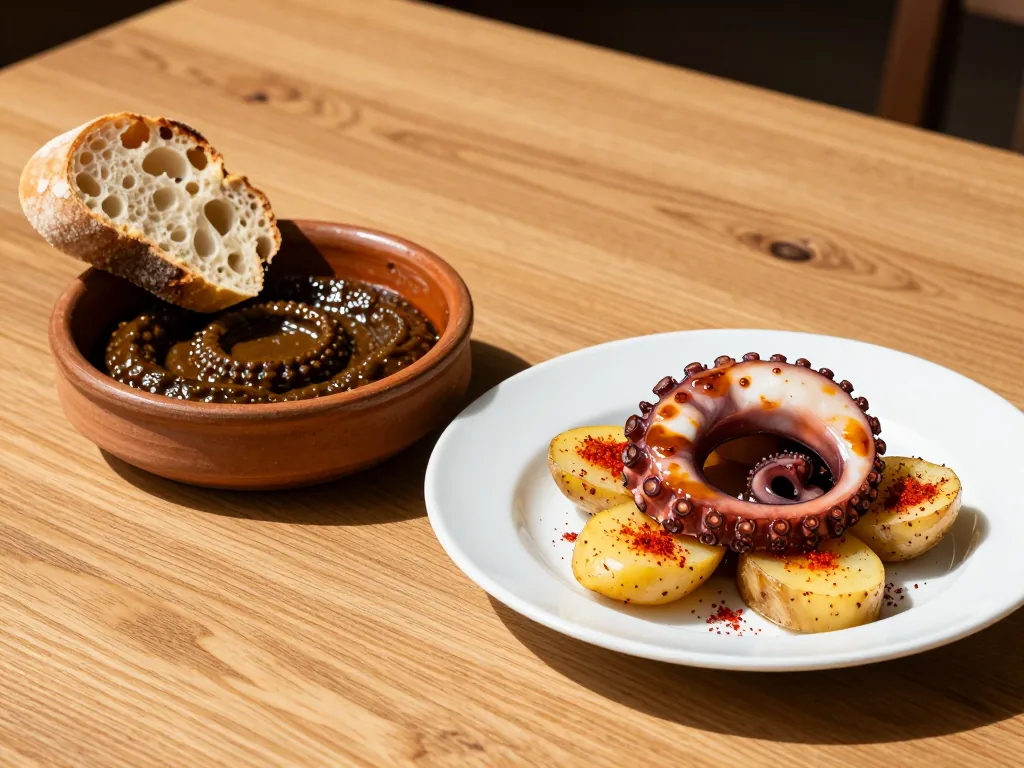
The iconic dish is Pulpo a la Gallega (Galician-style octopus). Boiled in a copper pot until perfectly tender, it is sliced into rounds and served on a wooden plate, dusted with sweet pimentón (smoked paprika), drizzled with fruity olive oil, and finished with coarse sea salt. The result is pure, elemental flavor—a testament to the quality of the ingredient itself. In local taverns and at festivals, a generous portion typically costs from €12 to €18.
Beyond octopus, the rías are a larder of shellfish. Mussels (mejillones), clams (almejas), and scallops (vieiras—the scallop shell is the symbol of the Camino de Santiago) are abundant. Often simply steamed in white wine, garlic, and parsley (marinera style) or grilled over open flames, a plate of mixed grilled shellfish at a seaside marisquería ranges from €20 to €35 per person, depending on the selection.
Perhaps the most portable expression of Galician cuisine is the empanada gallega. Unlike the small, fried turnovers of Latin America, this is a large, savory pie baked in a round or rectangular tin. The dough is enriched with olive oil and sometimes lard, then filled with a savory mixture. The classic filling is tuna (atún) or sardines (sardinas), often combined with sautéed onions, peppers, and tomato. Meat versions with pork or beef also exist, but seafood fillings dominate. A whole empanada, enough for four people, can be purchased from a bakery or market stall for €10 to €18.
The region’s wet, mild climate supports lush pastures for dairy, but seafood remains the star, with over 200 varieties of fish and shellfish available.
This bounty means even humble dishes are elevated by the sea. Caldo gallego, a hearty broth of greens, potatoes, and pork, might be enriched with a few clams. Lacón con grelos (boiled pork shoulder with turnip tops) is a winter staple, but it is the daily catch—from hake (merluza) to monkfish (rape)—that defines the Galician table. Here, the Atlantic is not just a backdrop; it is the very heart of the kitchen.
Castile and León: Roasts, Legumes, and Cured Pork
No region better encapsulates the soul of Spain’s interior than Castile and León. This vast, windswept plateau endures harsh winters, and the cuisine rewards patience. The cooking is unapologetically rustic, built around slow-roasted meats, earthy legumes, and some of the world’s finest cured pork. The landscape may be austere, but the table is generous.
Cochinillo Asado and Lechazo
The crown jewels of Castilian roasting are cochinillo asado (suckling pig) and lechazo (suckling lamb). Both are prepared with almost religious simplicity: the whole animal, seasoned only with salt, lard, and water, is slow-roasted in a wood-fired oven for hours. The skin crackles into a brittle, golden crust while the meat beneath falls apart at the touch of a fork. Traditional accompaniments are a simple green salad and perhaps a few roasted potatoes—nothing distracts from the purity of the roast. This food was born of necessity: the region’s harsh, dry winters demanded meals that could sustain laborers through long, cold days. The slow, steady heat of the wood oven was the only way to transform tough, young meat into something transcendent. A whole cochinillo in a traditional asador in Segovia or Aranda de Duero typically costs from €80 to €130 per person for a full menu, while a half-portion of lechazo might run from €25 to €45.
Legumes and Jamón Ibérico
Beyond the roasts, Castile and León’s larder is defined by legumes and cured pork. Chickpeas from Fuentesaúco, lentils from La Armuña, and beans from El Barco de Ávila are staples, slow-simmered in hearty stews with chorizo, morcilla, and often a chunk of pork belly. These cocidos are not quick affairs; they bubble for hours, absorbing the smoky, spicy depth of the sausages. The region also benefits from its proximity to Extremadura and La Mancha, where legendary jamón ibérico is produced. Acorn-fed Iberian pigs roam the dehesa and are cured for years, yielding a ham with rich, nutty flavor and melting fat. A whole jamón ibérico de bellota from these areas can range from €350 to €900 per ham (7–8 kg); a 100-gram serving of sliced ham costs from €12 to €30. The finishing touch for many Castilian dishes is pimentón de la Vera, a smoked paprika from the nearby Vera valley that imparts a subtle, charcoal-like warmth to stews, sausages, and even the roasting juices. Together, these ingredients form a cuisine humble in origin but profound in flavor—a true taste of the Spanish interior.
The Islands: Balearic and Canary Island Specialties
Spain’s culinary identity extends well beyond the mainland, and its two major archipelagos—the Balearic Islands in the Mediterranean and the Canary Islands off Africa’s northwest coast—offer some of the country’s most distinct and beloved specialties. Geography, climate, and centuries of trade have shaped these island cuisines, rewarding travelers with flavors you won’t find on the peninsula.
In the Balearics—Mallorca, Menorca, Ibiza, and Formentera—two iconic foods dominate local tables. First is sobrasada, a spreadable cured pork sausage made from ground pork, paprika, salt, and spices. Unlike firmer chorizo, sobrasada has a soft, almost pâté-like texture that melts on crusty bread or toasted pa amb oli (bread rubbed with tomato and olive oil). Generous amounts of pimentón (smoked paprika) give it a deep red color and a sweet, slightly smoky kick. A quality local roll, typically 300 grams, costs from €8 to €15 depending on the producer and curing time. The second essential is ensaimada, a light, airy spiral pastry of lard, flour, sugar, and eggs, dusted with powdered sugar. Traditionally a breakfast staple, it can be plain or filled with cabello de ángel (pumpkin jam), chocolate, or cream. A single plain ensaimada from a local bakery runs €2 to €5; larger, gift-wrapped versions cost €12 to €25.
The Canary Islands, by contrast, offer a completely different palate, shaped heavily by African, Latin American, and indigenous Guanche traditions. The soul of Canarian cooking lies in its mojo sauces. Mojo rojo—a vibrant red sauce of dried red peppers (often pimienta picona), cumin, garlic, olive oil, and vinegar—is spicy, earthy, and intensely flavorful. Mojo verde uses fresh cilantro or parsley, garlic, cumin, and sometimes green peppers, yielding a bright, herbaceous sauce. Both are indispensable with papas arrugadas: small, wrinkled potatoes boiled in heavily salted water until the skins shrivel and form a thin salt crust. A generous plate of papas with both mojos costs €5 to €10 in a local guachinche (rustic eatery). Another Canarian staple is gofio, a toasted flour of wheat, corn, or a blend, ground to a fine powder. It thickens soups and stews, mixes into desserts like bienmesabe (almond cream), or simply stirs into milk or broth for a hearty breakfast. A 500-gram bag of traditional gofio costs €3 to €7, making it an affordable pantry essential across the islands.
Conclusion
From the Atlantic seafood of Galicia to the sun-drenched rice fields of Valencia and the bold stews of Castile, Spain’s culinary landscape is a mosaic shaped by geography, history, and local pride. The key takeaway: there is no single “Spanish cuisine”—only distinct regional identities, each with its own signature ingredients and cooking techniques. To truly experience this diversity, let local food guide your itinerary. Seek out market stalls and family-run taverns where these traditions come alive. Whether you start with pintxos in the Basque Country or gazpacho in Andalusia, every region tells a new story through flavor.